I just love a good mystery novel, when you get wrapped up in the made up world the author has created; ponder over the clues, analyse suspects, muse on the final reveal. When we finally solve the mystery, we dwell on the marvel of the twists in the plot for a time, then normality resumes in the lives of protagonist and reader alike.
And so it is that the mysteries behind the Lady and the Unicorn tapestries haunt me constantly, and I can not let go as if they are characters in an incredible book, once read and never forgotten. I was fortunate to view the beautiful Lady and her Unicorn in person whilst they were exhibited in Sydney in 2018, and oh how tempting it was to stay all day, to sit and observe and breathe in by osmosis my new friends.
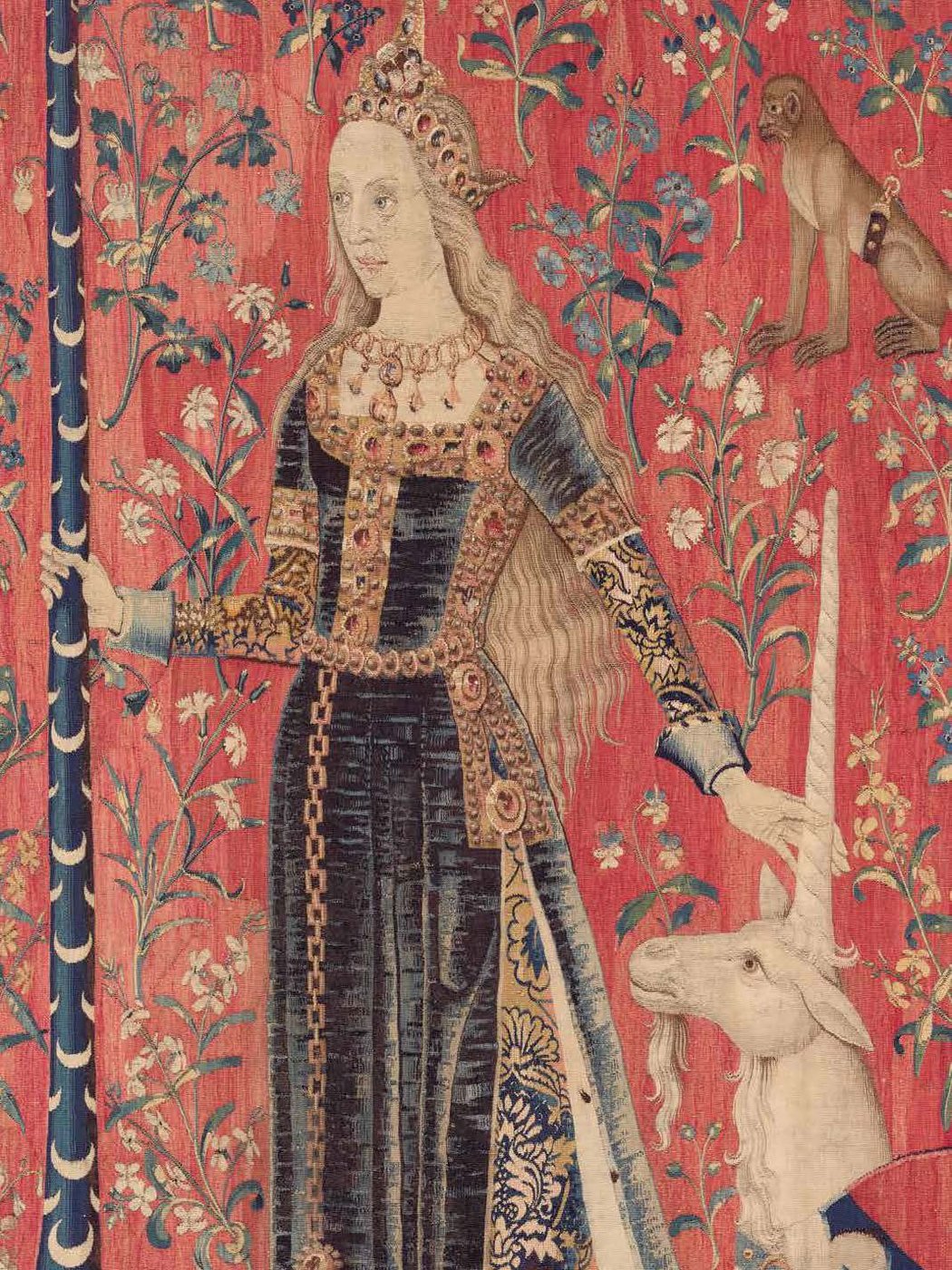
These tapestries, rich in heraldry and symbolism, evoke the essence of the medieval world. But it is the stories behind the tapestries that inhabit my dreams and daydreams, and fill my notebooks with thoughts and many question marks, and inevitably, threads of story ideas.
We know the Le Viste family (either John or Jean) commissioned these extravagant heirlooms, around 1500. We know that the Aubusson workshops would have worked on them for several years. We have a fairly good idea how they came to be hanging in the romantic Château de Boussac, and then to the attention of the Cluny Museum and finally acquired by the museum in 1882, in a sad state of disrepair …
“They have long been left to the rats, fading over the centuries …”
George Sand, 1847
But there are parts of the timeline of the Lady and the Unicorn tapestries that are unknown, and here is where my imagination comes to play. What was it like, the day that these large packages arrived at the family estate. Being portable and commonly transported between family estates, what was the grand home where they were first hung? And what were the reactions when everyone first saw them set in place, with the rich red backgrounds scattered in millefleur, the deep cobalt blue of the lady’s gown, the forest green trees full of flowers or fruits, the sparkling white of the unicorn horn. Did it affect the people it was designed to impress? What did the servants think, as they carried on with their tasks. Did they sneak in friends and family to take a glance? Were the meanings of each panel obvious to all? Did the household children have their favourite image, one of the charming creatures perhaps or a luxurious dress or opulent jewels worn by the lady. Perhaps the owners had many a grand party, inviting their wealthy and powerful neighbours to come ogle over this obvious display of affluence and importance.
And of the generations that followed the Le Viste family of 1500, what did they think of these wall hangings? And what of their own lives, their daily tribulations, whilst the tapestries hung, silently observing, on the walls behind them?
And who exactly was this beautiful lady of the forest, with her fine clothes and long blonde hair, her lion and her unicorn, and her menagerie of exotic animals? Was she created to represent a real person, and if so, who? Were these tapestries commissioned as a wedding gift, or in honour of a particularly special woman?
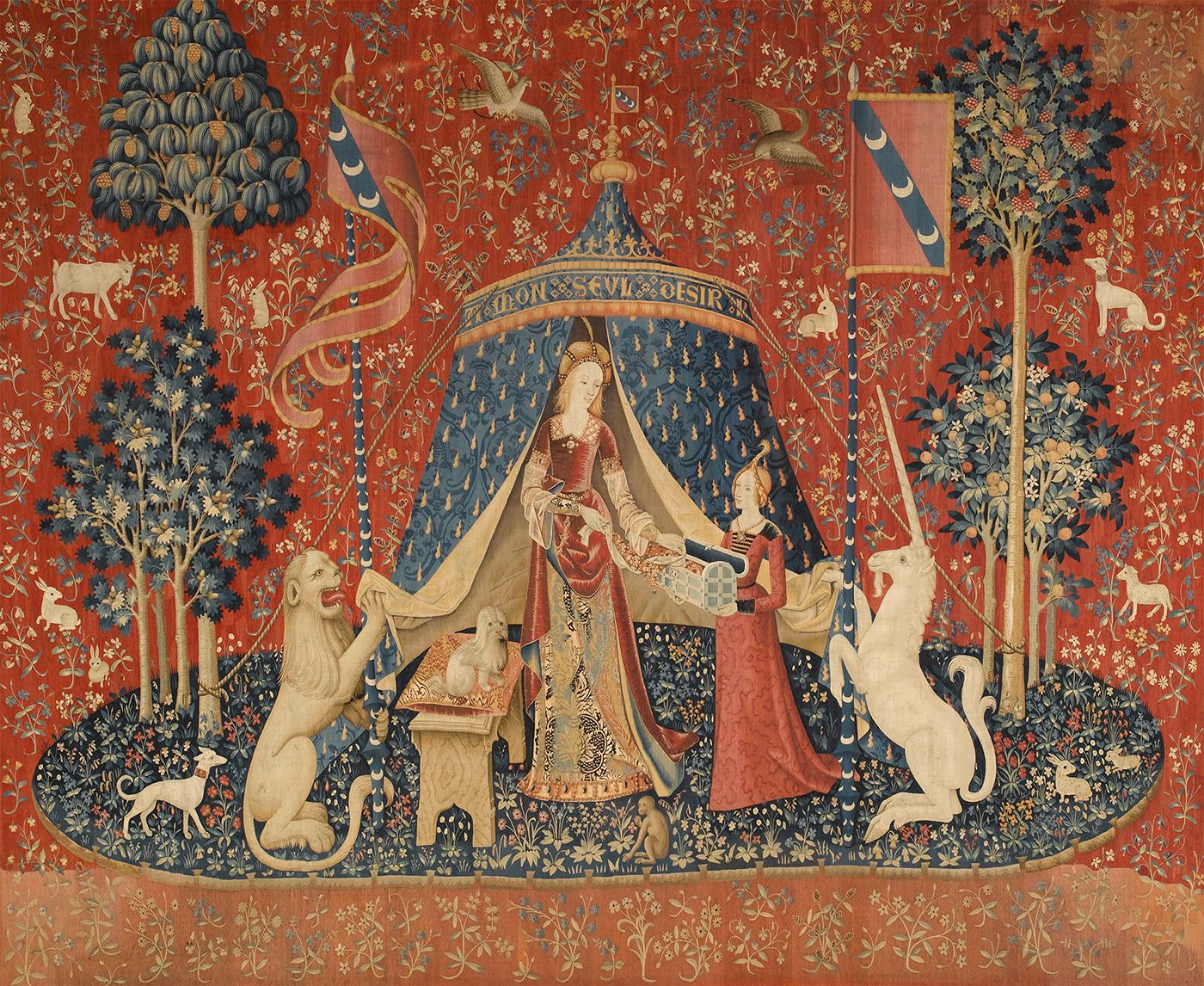
There are six tapestries (that we know of – perhaps there were more), five depicting the five senses; Hear, Touch, Smell, Sight, and Touch. Then we have the final tapestry, but in this one the message is uncertain. There is a tent behind the lady, with the banner, ‘Mon Seul Desir’. She is putting away (or putting on) her jewellery, worn in every other hanging. There are a few different interpretations of what this could mean, how the panel fits in with the other five pieces. I personally prefer the meaning that this is the merit of free will, ‘my desire alone’ translating to ‘my will alone’ (A.Erlande-Brandenburg, 1978). Another hypothesis is based on text by the Florentine philosopher Marsilio Ficino (circa 1468), where he proposes that a man has six ways to attain beauty, through the five senses and also through the mind, or, comprehension. Thus, the sixth sense of “Mon Seul Desir” would define beauty of the soul, one’s sole object of desire.
Dear reader, as I let my imagination head off in another daydream of unicorns and rabbits and ladies in sumptuous dresses, I invite you to check out this fascinating YouTube clip discussing the mysteries of the tapestries and the recent restoration work.
In other news, I’m working hard on the current MIP (manuscript in progress), and am happy to report the half way mark on this first round of edits has been reached. The plan is to finish this second draft between now and the Christmas break, take a few weeks off, then tackle the manuscript with fresh eyes in the New Year.

Bedside reading: Writing the Stars, by Shauna Bickley
What’s on Audible: The Light Between Oceans, by M.L. Stedman (through Overdrive app, loan from the library)
What’s on Podcast: Kobo Writing Life
Feature image of the sixth tapestry, ‘À mon seul désir‘ attributed to: https://www.tchevalier.com/unicorn/tapestries/desir.html#



 Gathering Words
Great post. I love the imagination and recreating the lives of these tapestries. That’s exactly what I do in castles! I’ve always loved these images, and it’s good to see someone exploring them. 🙂
LikeLiked by 1 person